Product requirements, without theater
Turn the idea into a PRD people can build from.
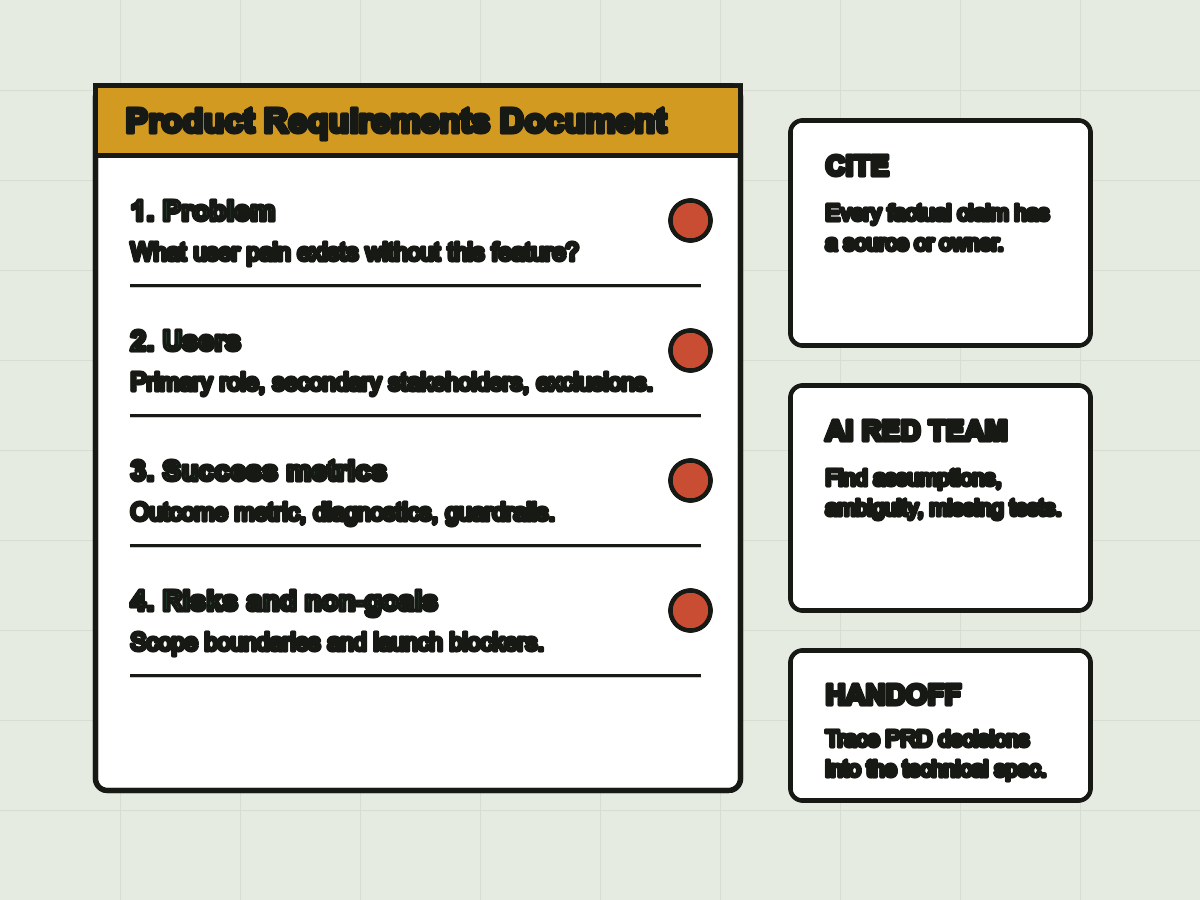
How do I write a PRD? Start with four decisions: the problem that exists even if the feature never ships, the user whose behavior must change, requirements as observable behavior with acceptance tests, and non-goals that stop silence from becoming scope. The PRD Bench is an interactive builder for those four sections, not a spec bench. Technical interfaces belong at idea2spec.com. Stamp a section only when it can survive review.
Signature experience
The PRD Bench writes the four decisions most PRDs skip.
Problem, users, requirements, and non-goals. Not interfaces, not data models, not a spec. Load a weak dashboard draft, rewrite one station, and stamp a section only when a reviewer could accept it.
What this guide is for
A PRD is the product decision record between idea and execution.
It should clarify the problem, user, scope, success measures, and risks before downstream work turns into design files, technical specs, tickets, prompts, or agent tasks.
Key facts
- Owned lane
- Idea2PRD covers product requirements: problem, user, goal, non-goal, metric, risk, and handoff clarity.
- PRD Bench
- The signature experience is a four-station section builder at /prd-bench/. It is not a spec bench.
- Next artifact
- After the PRD is accepted, hand the product intent to a technical spec or implementation plan.
Guide map
Write the doc that matches the risk.
Start with anatomy, choose the right weight, draft with AI only where it helps, then hand the product decision to engineering with traceable acceptance criteria.
start by defining the customer experience